

Decentralized Finance, commonly known as DeFi, represents one of the most transformative innovations in the cryptocurrency space. It refers to a collection of financial applications built on blockchain networks that operate without traditional intermediaries like banks, brokerages, or exchanges. Instead, these services run on smart contracts, which are self-executing programs that automatically enforce the terms of financial agreements.
The DeFi movement aims to recreate and improve upon traditional financial services in an open, permissionless, and transparent manner. Anyone with an internet connection and a crypto wallet can access DeFi applications, regardless of their location, credit history, or financial status. This democratization of finance has attracted billions of dollars in value and millions of users worldwide.
By the end of this guide, you will understand how DeFi works, the various types of protocols available, the potential benefits and risks involved, and how to safely participate in this emerging financial ecosystem.
The History and Evolution of DeFi
The roots of DeFi trace back to the creation of Bitcoin in 2009, which introduced the concept of peer-to-peer digital money without central authority. However, Bitcoin's scripting language was intentionally limited, making complex financial applications difficult to build. The true birth of DeFi came with the launch of Ethereum in 2015, which introduced a Turing-complete programming language capable of running sophisticated smart contracts.
The term "DeFi" was coined in August 2018 during a Telegram chat among Ethereum developers and entrepreneurs. They were seeking a name to describe the growing ecosystem of open financial protocols being built on Ethereum. The name stuck, and a movement was born.
MakerDAO, launched in 2017, is often considered the first major DeFi protocol. It introduced DAI, a stablecoin backed by cryptocurrency collateral rather than traditional bank reserves. This demonstrated that complex financial instruments could exist entirely on the blockchain. In 2018, Compound launched, allowing users to lend and borrow cryptocurrencies through algorithmic interest rates. Uniswap followed in late 2018, pioneering the Automated Market Maker (AMM) model that would revolutionize decentralized trading.
The summer of 2020 became known as "DeFi Summer" when yield farming and liquidity mining rewards drove explosive growth. Total Value Locked (TVL) in DeFi protocols surged from around $1 billion in June 2020 to over $15 billion by September. New protocols launched daily, and users flocked to earn high yields on their crypto holdings. While many of these early yields were unsustainable, the period established DeFi as a legitimate sector within cryptocurrency.
How Does DeFi Work?
DeFi applications operate through smart contracts deployed on blockchain networks. These contracts contain code that automatically executes when certain conditions are met. For example, a lending smart contract might automatically release collateral when a loan is repaid, or liquidate collateral if its value falls below a certain threshold. No human intervention is required, and the rules cannot be changed arbitrarily by any single party.
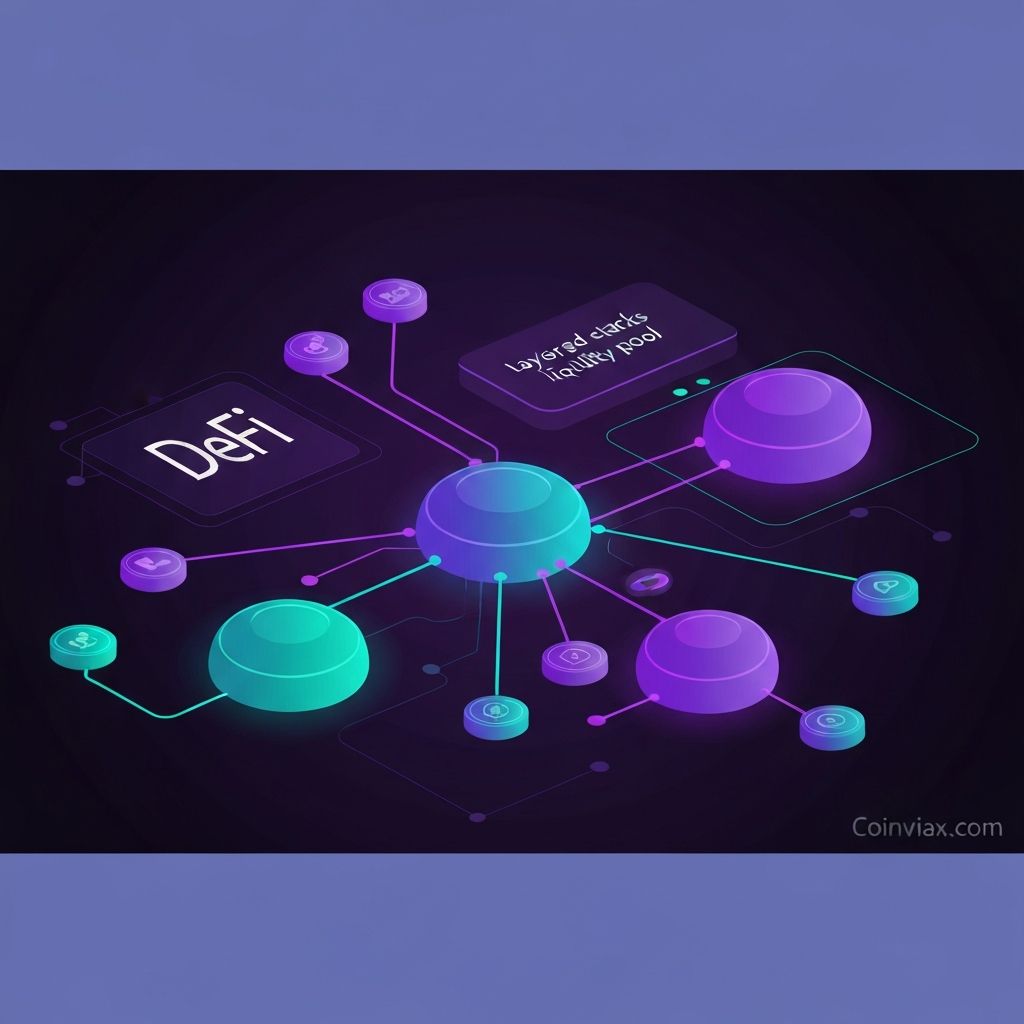
The foundation of most DeFi activity is the concept of liquidity pools. These are collections of tokens locked in smart contracts that provide the capital necessary for various financial operations. When you deposit tokens into a liquidity pool, you receive LP tokens representing your share of the pool. These pools enable decentralized exchanges to function, lending protocols to issue loans, and yield aggregators to optimize returns.
Composability is another crucial concept in DeFi. Because all protocols operate on the same blockchain and follow common standards, they can interact with each other seamlessly. This is often called "money legos" because different protocols can be stacked together to create complex financial strategies. For instance, you could deposit ETH into a lending protocol, borrow stablecoins against it, and then use those stablecoins to provide liquidity on a decentralized exchange, all in a few transactions.

DeFi vs Traditional Finance
Understanding how DeFi differs from traditional finance helps clarify its value proposition. The following table compares key characteristics of both systems:
| Characteristic | Traditional Finance | DeFi |
|---|---|---|
| Access | Requires identity verification, credit checks, minimum balances | Open to anyone with internet and a wallet |
| Operating Hours | Business hours, weekdays, with holidays | 24/7/365, no downtime |
| Transaction Speed | Days for settlements, wire transfers | Minutes to hours depending on network |
| Transparency | Limited, proprietary systems | Fully transparent, auditable on-chain |
| Custody | Institution holds your assets | You control your own assets |
| Interest Rates | Set by institutions, often low | Market-driven, often higher |
| Geographic Limits | Restricted by jurisdiction | Borderless, global access |
Traditional financial institutions act as trusted intermediaries that verify identities, assess creditworthiness, and guarantee transactions. In DeFi, these functions are replaced by cryptographic proofs and algorithmic processes. While this removes many barriers to access, it also shifts responsibility for security and due diligence to the individual user.
Types of DeFi Protocols
The DeFi ecosystem encompasses a diverse range of financial services. Each category serves different needs and carries its own risk profile.
Decentralized Exchanges (DEXs)
Decentralized exchanges allow users to trade cryptocurrencies directly with each other without depositing funds on a centralized platform. Unlike traditional cryptocurrency exchanges like Binance or Coinbase, DEXs never take custody of your assets. The most popular DEXs use the Automated Market Maker (AMM) model, where liquidity pools replace traditional order books.
Uniswap is the largest DEX by trading volume, operating primarily on Ethereum and several Layer 2 networks. SushiSwap, Curve Finance, and Balancer offer variations on the AMM model optimized for different use cases. Solana has its own DEX ecosystem with platforms like Raydium and Orca, while PancakeSwap dominates the BNB Chain.
Lending and Borrowing Protocols
Lending protocols enable users to earn interest by supplying their crypto assets to liquidity pools, while borrowers can take out overcollateralized loans against their holdings. Unlike traditional loans that require credit checks, DeFi loans are secured entirely by collateral. If the collateral value drops too low, the protocol automatically liquidates it to repay lenders.
Aave and Compound are the leading lending protocols on Ethereum. They support dozens of assets and offer both variable and stable interest rates. MakerDAO takes a different approach, allowing users to mint the DAI stablecoin against their collateral. These protocols have proven remarkably resilient, processing billions in loans with minimal bad debt.
Yield Aggregators
Yield aggregators automatically move your funds between different DeFi protocols to maximize returns. Instead of manually searching for the best yields and paying gas fees to rebalance, these platforms handle optimization automatically. Yearn Finance pioneered this category with its "vaults" that execute complex yield strategies on behalf of depositors.
Stablecoins
Stablecoins are crucial infrastructure for DeFi, providing price stability in an otherwise volatile market. While centralized stablecoins like USDT and USDC are backed by traditional assets, algorithmic stablecoins maintain their peg through on-chain mechanisms. DAI uses overcollateralization, while newer designs experiment with different stabilization methods.
Derivatives and Synthetic Assets
DeFi derivatives allow users to gain exposure to various assets without holding them directly. Synthetix enables creation of "synths" that track the price of stocks, commodities, and cryptocurrencies. Perpetual protocols offer leveraged trading with perpetual futures contracts. These platforms bring sophisticated financial instruments to permissionless markets.
Insurance Protocols
Given the risks inherent in DeFi, insurance protocols have emerged to provide coverage against smart contract failures, hacks, and other losses. Nexus Mutual and InsurAce allow users to purchase coverage for specific protocols. Payouts are typically governed by token holder votes on whether claimed events qualify for compensation.
Benefits of DeFi
DeFi offers several compelling advantages over traditional financial systems that have driven its rapid adoption.
Permissionless access stands as perhaps the most significant benefit. An estimated 1.7 billion adults worldwide lack access to traditional banking services. DeFi requires only an internet connection and a crypto wallet, enabling financial inclusion for underserved populations. There are no credit checks, no minimum balances, and no account approval processes.
Transparency distinguishes DeFi from opaque traditional systems. Every transaction, every smart contract, and every protocol parameter is visible on the blockchain. Users can verify that protocols function as advertised, audit reserve levels in real-time, and track exactly where their funds go. This transparency builds trust through verification rather than relying on institutional reputation.
Self-custody means you maintain control of your assets at all times. Unlike depositing money in a bank or crypto on a centralized exchange, DeFi protocols cannot freeze your funds or deny withdrawals. Your private keys give you absolute control, eliminating counterparty risk from custodians.
Efficiency and speed improve upon traditional finance significantly. Transactions settle in minutes rather than days. Smart contracts execute automatically without manual processing. Operating costs are lower without physical branches, large workforces, or legacy technology systems, allowing protocols to pass savings to users through better rates.
Innovation and composability enable rapid experimentation. Anyone can build new DeFi applications without seeking permission from gatekeepers. The open-source nature means successful innovations can be quickly adopted and improved upon. The "money legos" concept allows complex financial strategies that would be impossible in siloed traditional systems.
Risks and Challenges
While DeFi offers significant benefits, participants must understand the substantial risks involved. These risks have resulted in billions of dollars in losses since DeFi's inception.
Smart contract risk remains the most fundamental danger in DeFi. Despite audits and testing, bugs in code can lead to catastrophic losses. The immutable nature of blockchain means flawed contracts cannot easily be fixed once deployed. In 2016, the DAO hack exploited a vulnerability to drain $60 million in ETH. More recently, numerous protocols have lost funds to exploits targeting overlooked edge cases.
Market and liquidation risk affects anyone using leveraged positions or collateralized loans. Crypto markets can move 20% or more in a single day. If collateral values drop rapidly, liquidations can cascade, worsening price declines. During March 2020's "Black Thursday," rapid ETH price drops caused $8 million in bad debt on MakerDAO when liquidations failed to execute properly.
Impermanent loss impacts liquidity providers on AMM-style DEXs. When token prices diverge from when you deposited, you end up with less value than if you had simply held the tokens. For volatile pairs, these losses can exceed the trading fees earned. Understanding this risk is essential before providing liquidity.
Regulatory uncertainty clouds DeFi's future. Governments worldwide are still determining how to classify and regulate these protocols. Some jurisdictions have taken enforcement actions against DeFi developers and users. The permissionless nature of DeFi makes compliance challenging, potentially exposing participants to legal risks depending on their jurisdiction.
User error and scams account for significant losses. Sending funds to wrong addresses, approving malicious contracts, or falling for phishing attacks can result in permanent loss of funds. Unlike traditional finance, there is no customer service to reverse erroneous transactions or recover stolen assets.
How to Get Started with DeFi
Entering DeFi safely requires careful preparation and a methodical approach. The following steps will help you begin your journey:
- Set up a non-custodial wallet: Download a reputable wallet like MetaMask for Ethereum-based DeFi or Phantom for Solana. Secure your seed phrase offline in multiple locations. Never share it with anyone or enter it on websites.
- Acquire cryptocurrency: Purchase ETH or other base layer tokens from a trusted exchange. Transfer to your non-custodial wallet. Start with small amounts while learning.
- Research protocols thoroughly: Before depositing funds, understand how each protocol works. Read documentation, check audit reports, and verify smart contract addresses. Use established protocols with long track records initially.
- Start with simple activities: Begin with basic swaps on a DEX like Uniswap or simple deposits to lending protocols like Aave. Avoid complex strategies until you understand the fundamentals.
- Monitor your positions: DeFi requires active management. Track your deposits, check collateral ratios on loans, and stay informed about protocol updates or security concerns.
Major DeFi Protocols to Know
The following table summarizes some of the most established DeFi protocols across different categories:
| Protocol | Category | Primary Chain | Key Feature |
|---|---|---|---|
| Uniswap | DEX | Ethereum, L2s | Largest DEX by volume |
| Aave | Lending | Multi-chain | Flash loans, multiple assets |
| MakerDAO | Stablecoin | Ethereum | DAI stablecoin creation |
| Curve Finance | DEX | Multi-chain | Optimized for stablecoins |
| Lido | Staking | Ethereum | Liquid staking derivatives |
| Compound | Lending | Ethereum | Algorithmic interest rates |
| Yearn Finance | Yield Aggregator | Ethereum | Automated yield optimization |
| GMX | Derivatives | Arbitrum | Perpetual trading |
The Future of DeFi
DeFi continues evolving rapidly with several trends shaping its future direction. Layer 2 scaling solutions like Arbitrum and Optimism dramatically reduce transaction costs, making DeFi accessible to users who cannot afford high Ethereum gas fees. Multi-chain expansion brings DeFi to faster networks like Solana, Avalanche, and Polygon.
Real-world asset tokenization promises to bring traditional assets on-chain. Protocols are experimenting with tokenized treasury bills, real estate, and other conventional investments. This bridges the gap between DeFi and traditional finance, potentially unlocking enormous new markets.
Institutional adoption is gradually increasing as compliance tools improve and regulatory clarity emerges. Major financial institutions are exploring DeFi for settlement, custody, and trading applications. This legitimization could bring significant capital but may also increase pressure for regulatory compliance.
Despite challenges, DeFi has demonstrated remarkable resilience and innovation. The technology continues maturing, user interfaces are becoming more accessible, and the ecosystem keeps expanding. For those willing to learn and manage the risks, DeFi offers unprecedented access to financial services and opportunities that simply did not exist a decade ago. Whether you are seeking higher yields, financial inclusion, or simply want to understand this transformative technology, now is an excellent time to explore what decentralized finance has to offer.
